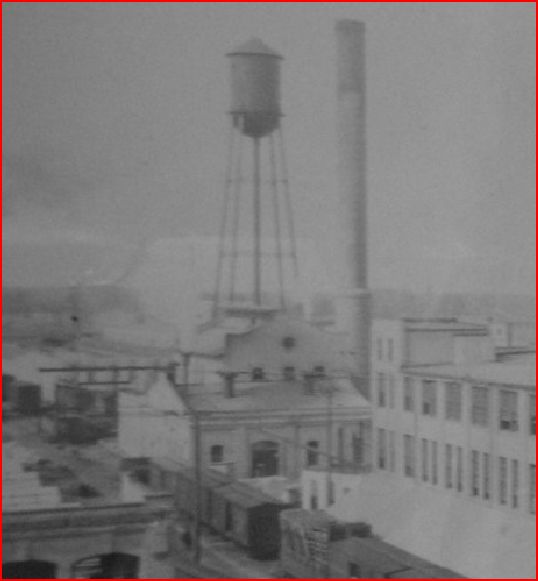
Wednesday, June 26, 2013

Industrial & Hamilton Avenues

Before the Industrial Bank was built on the corner as shown below.
I know it's hard to believe but I have never posted this photo before. You are looking north up Industrial Avenue from Hamilton Avenue in 1910 during a shift change or lunch.
Here is a little different view of the same intersection taken from the roof of the W.F.Stewart body factory in 1910 showing the Oak Park subdivision after it has been built. That is the Weston-Mott factory on the right with the new Industrial bank now located just west across Industrial Avenue. The bank was originally located in the Stewart factory.  Links: 

Hamilton and Industrial Industrial and Hamilton Early views of Buick & Weston-Mott. Industrial and Hamilton Avenue Industrial & Hamilton Avenue 1913 Weston-Mott At Industrial & Hamilton Industrial and Hamilton Showing Oak Park Subdivision Weston Mott & Industrial Bank Weston Mott 1906-1909 Weston Mott 1909  

The Weston-Mott Factories At Buick Industrial & Hamilton Avenue 1915.

Tuesday, June 25, 2013

Division Street Gate.

This is the same gate as shown below only in 1974. That is body receiving shown in the foreground and mentioned below. That is factory #44 being built. I entered this gate more than any other in my 30 years with G.M. and it was also my first and last at Buick.

Factory #44 During Construction  Factory #44 Site Through The Years

This view facing northwest is the same gate as shown in the photos above and below. That is body receiving in the background. I like the sign at right: BEAT OLD AGE & GOUT 30 & OUT  Story about 30 & out September 1971. These workers are the reason I am enjoying retirement today instead of laying in a casket. 
This ghost image shows the Buick factory in 1910 at the same location as shown above & below.  

Ghost Of The Past

This would be the most photographed entrance of the Buick factory in Flint, Michigan.   This photo I took is included in the newest book published  about Flint by author Gordon Young.  The book is titled... Teardown: Memoir of a vanishing city.                                                                                                                                                                                      Links: 

Division Street Revisited. Division street During 100 Years. Division Street 1947 Body Receiving 1960 


Monday, May 27, 2013

Buick GS Stage 2

This article from my Muscle Review magazine (no longer published) dated July 1999 tells a  short story about a pretty rare 1970 Buick. This article also happens to mention the opening of the (then new) Buick museum in Flint.  The following is from my book Buick Muscle Cars by: Bill Holder and Phillip Kunz.   A Stage 2? It may not be a well known fact, but there was also a so-called stage 2. In 1968, the buyer of a Gran Sport Skylark could check off the Stage 2 package,which offered a pure race option consisting of an ultra-high-performance engine and some other performance options that had to be installed by the dealer. Few knew that the option even existed. Obviously  the option was designed for drag racers.   The Stag 2 package was again available in 1970 with a trunkful of performance goodies. Included were Mickey Thompson headers, an 850 cfm Holley carburetor, 12.5:1 compression ratio forged pistons, a high-performance cam, and new high-flow heads. There was also a 4.78 geared rear end. All the equipment was reportedly dealer installed.   How many Stage 2 cars were modified is not known, but rest assured, the numbers are few. In fact, it has been noted that only three are known to exist, showcasing possibly the most daring Buick adventure into high performance. 
GSX Stage 2 resized
Hemmings Muscle Machines subscribers (and those who pick it up on the newsstand) may recall from our recent All Modified issue the Buick pictured above: A contemporary recreation of the 1970 Buick GSX Stage2 prototype. The six-page feature recalls Frank Urbinati’s desire to recreate the lost factory GSX, how Gransport Auto Body built it, and how it ended up in the hands of its current owner, Bob Ortolani, who continues its 9.51-second quarter-mile legacy. The story also provides some background as to the one and only original prototype, including its oft-repeated demise – set in motion by the rapid swing away from muscle cars in 1971 – that began with dismantling, followed by its complete destruction in a fire.
Not long ago we received a letter from Dennis Manner, a now-retired Buick/GM engine engineer who has vast first-hand knowledge of not only Buick’s engine development in the Sixties and Seventies (including his direct involvement with the 455, 455 Stage 1 and 455 Stage 2 equipment), but also the development of the GSX Stage2 prototype and its true demise. According to Dennis:
I don't know how the story ever got started about the prototype car ever catching on fire which was not true and I have been trying to correct that statement ever since. In addition to the Stage 2 development car I used as a workhorse at Buick Engineering, we built a prototype GSX car in Flint in Buick Engineering and sent it out to California for exposure and evaluation for the dealers, the racers and the magazine writers. Upon its return to Michigan long after we had decided to not factory produce the package and we were about to retire the vehicle, one of our Buick engineers missed a shift driving it at our GM proving grounds and put a rod through the side of the block. It did not catch fire. We then disassembled the car, scrapped it out but the special hood was donated to the Jones/Benesick Buick drag car they raced in California.
Special thanks goes out to Dennis for clarifying what happened to perhaps one of Buick’s ultimate performance cars.  Original link here.  This article is from my December 2012 issue of Hemmings Muscle Machines and contains new information concerning this rare Buick. I actually  took this copy from the Hemmings site because I gave my issue to another enthusiast (my Dentist) who needed another article for the 409 Chevy engine he has.   The following link provides another history lesson.

1970 455 Stage III Block!   
Many different versions of this engine and the cars history are still clouded. Some say 2 were built by the factory and some say 15 dealer installed's were built. Some also say around 75 sets of the special heads required were made. I like the first story at the beginning that leads off with: THE FINAL Chapter which I find doubtful.   Images here.

Tuesday, May 14, 2013

Buick site 1912.

This advertisement is from the Collier's magazine of January 1912.  Link for original site: Collier 1912.  Breakdown of the plants size and men and cost.   January 1912 story about dealer visit.
The long building east of factory #12 listed as receiving rooms was never built. A much smaller factory for Buick enameling designated #05 was built on that site in 1914. The map for the proposed wiring of Buick in 1911 shows this same planned building being used for Brass & Aluminum and other discrepancies.  

General Electric Wires Buick In 1911. 


The spring works is actually the Armstrong plant in the left foreground. The building shown as the spring plant here is actually the Flint Axle Works at this time. The Buick garage #08 is mis-labeled as #9, number 9 is shown correctly above as warehouse shipping.

Armstrong Spring Company and; Marvel Carburetor Co.. Oak Park Industries


Some buildings and designations are not correct in this rendering of the factories located in the Oak Park Industries in north Flint. The following links show the actual buildings from left to right: Ignition Works, Body Works Body Works,  Salesman garage sundries, Varnish Works, Main Office, rear axles and differentials, Heating and lighting plant, Engineering machine shop transmission, Gray Iron Foundry, Wheel Works, 10 Assembling rooms, 7 Assembling rooms, 6 Assembling rooms,  9 Warehouse Shipping, Brass Bronze Aluminum 12, Receiving rooms not built, #05 instead, Power Plant,  3 Drop Forge, Hubs and Rims, 14 Assembling 14 was the model auto built here, with the building being designated #16, Test Track,  11 Motor Works.        
This 1910 Limousine would be the first closed body Buick and these were assembled in factory #10. The bodies came from the Fisher Brothers in Detroit at this time. The following model Buick's are the ones shown being built in the above rendering of the Buick factories. There were numerous other models actually built in 1912. These are from George Dammann's book "Seventy Years Of Buick".


                                                                                                                                                                                                      March 1911.                                                                                                                                                                                                                                                                                                                                                                            February 1912.       

Monday, May 13, 2013

Buick Minload.

This photo acquired at a luncheon with some past employees from Buick was sent by Leonard Thygesen. Anybody that has any information concerning this event please let me know.

Panoramic View 2013.

A quite unique panoramic view from the Leonard Thygesen collection. This is the view from the old Bell Produce building located in the old Buick Heights on April 26, 2013. This view is facing west showing the whole Buick site. As always you can enlarge this photo.  Links: 

Leonard Thygesen Demolition Videos and Buick Prints. Powertrain Flint North Demolition 2011- 2012. Buick Site June 7th 2012. Factory View From Leonard Thygesen. Buick Powertrain North Clean Up. Some Last Looks At Buick Powertrain. Factory #30 Beginning To End. 

Thursday, May 9, 2013

Terry Dunham Research.

The Buick factory race team boxcar in front of Buick factory #06.  To read two interesting  articles written by Terry Dunham go to the following links: Cobwebs and Overhead Valves.....Something Wicked This Way Comes: The Buick Race Cars From Hell. These are in easy to view PDF format.
Terry Dunham.
Link:

Terry B. Dunham  
 This cover is From my own collection.


Friday, April 26, 2013

Oak Park Power Company


This is facing north in 1907. You can see factory #06 in the background at the right just being built. This factory was for the model 35 and 34 Buick's. Electrical Review September 1906 update.

This view in 1907 shows the trees in the background running parallel with the rail line. You can also see factory #06 is in place in the background just beyond the Oak Park powerhouse. The two smoke stacks #46 at the right are from the Imperial Wheel works Company just barely visible.  You can see the area behind the factory is being graded in preparation for factories #07 and #10. Incorporation August 16, 1906.


Factory #06 is just visible off to the right in the distance. Mostly the Hamilton farm hay fields are still in place in this 1907 photo. I have still not found concrete evidence for the location of the Hamilton farm house. I may have seen it over near the rail line but have no close up that shows enough detail.  
The red arrow points to a new (steel) water tank being constructed in 1909.  The wooden tank has not yet fallen judging by the photo below which shows both tanks during the construction of this one.  Two tanks will be built in 1911 north of factory #02. This north-west view barely shows the smokestack of the powerhouse emitting smoke above factory #01 at the left. The tall metal stack  coming out of #01 was taking paint fumes out when this was the paint shop and transmission plant combined. Engines at this time were still coming from the Kearsley Street factory that was the first in Flint but was renumbered factory #02 after 1906. Go to the following link 

Buick Assembly Court Yard.

 and look at the second photo, just above the word CO. on the side of factory #01  just to the right you will notice the leftover stump of the steel stack mentioned above. 

 This would be shortly after the wooden tank fell. The new steel tank shown here is the same as what would be built in it's place. This particular tank did not last very long because it was in the way of future expansion.  Go here for more views of this area.
This photo is actually a little later than the one below. Factory #07 is almost complete and will  assemble the model 43 Buick's shortly. Factory #10 already has the second floor being erected. This #10 should not be confused with plant #10 built at the beginning of World War II. The men in charge and the location shown above is from the Flint City Directory of 1915.

This closeup of the Oak Park Power Company would have been taken while factory #07 is just being built in the background during 1908. You can see the one story gas house has also been rebuilt on the north side of the powerhouse. I still do not have much information on the gas house other than what is reported in the insurance article. I did find that Buick built a new gas plant in Grand Rapids, Michigan in 1913 for what it's worth.


Go here for actual site


This west view shows Weston-Mott #2 in the background.
This east view shows Buick #07 in the background.
The yellow lines show the exact spots in all three pictures. This is the same as described further below. Basically we're seeing the two different water tanks used for the fire suppression system. The blue outline shows the addition done to factory #01 which saw many such additions from 1906 to it's end in 1963. The green outline  shows the added smoke stack and enlargement of the powerhouse to the north. You will notice in the color postcard view that the powerhouse did not yet have a proper brick smokestack. Go to the following link for a seldom seen view of the second water tank. 

Postcard Find

The yellow line points out the same spot in this before and after shot of the powerhouse facing north. The original is hardly recognisable after all the expansions.
Just a bit different view north up the old rail spur between the factories. Some of these rails were left in place and could still be found in some areas covered with blacktop (Tarvia-top) in the early 1980's before the creation of Buick City. In my time this was the entrance off of Hamilton Avenue to factory #04. The #31 should not be confused with the axle plant #31 that took over this number after World War II.
Showing how large the powerhouse became in two years. Factory #10 just to the right or north of the water tower (in the 1908 view)  is shown larger than it would actually be when built in 1909. Factories #06, #07, #10 and #16 were all built using the same blueprint. The small structure shown at the southeast corner of factory #01 (left foreground) was never built.
Showing the proposed east annex of the powerhouse that is shown further below. Go here for the east annex view.
Just a closeup of the #26 powerhouse sometime after 1910 because factory #10 is now shown directly north. Factory #10 was the model 28 and 29 assembly plant at this time, with the closed body Buick's being built there in 1916. Touring cars were still the norm. in 1910.
This 1911 layout is not all entirely correct. The Brass works and truck garage proposals shown were not built in these locations.  Click on the link for the complete story: General Electric wires Buick.
I have found nothing further on this explosion at the powerhouse in 1912. This was found in the "Locomotive  Trade".
Facing north over the Buick site in 1920. You can see the new #14 powerhouse being built on Leith Street which will replace #26. I have also marked the location of the (far in the future)  #07 powerhouse that replaced #14 in the early 1970's. The old Weston-Mott powerhouse #6 was renumbered Buick #36 in 1913. The #36 designation would be used again later for the engine plant in the early 50's.
Here we can see the east wall of #26 shortly before demolition. This portion of the powerhouse only lasted 10 years.
This east facing view has Hamilton and Industrial Avenue in the lower foreground. The main building of the powerhouse #26 has the two large stacks. The small stack in the distance would at this time be #36 power house which is the old Weston-Mott #6.
This east facing close-up shows a conveyor leading to the power house. This is after the #14 power plant on Leith Street has been built so this was not used for long as shown below.
Facing south during demolition in 1921. This is the coal off-loading area for #26 powerhouse. Barely visible at the left is factory #07. Look to the far distance in the right background for the bridge that connects factory #08 with #04. You will notice the northern most smokestack has now been almost entirely removed. Paul Williams who does the Buick facebook site had no further information on this photo.
I think this is late 1909. This view is facing west,

This view is facing south-west.